

Want to teach your children Vietnamese but don't know where to find good learning materials? Here's a wonderful free resource worth bookmarking!
For Vietnamese families living abroad, helping our children learn and maintain their Vietnamese can be both rewarding and challenging. We want them to speak with their grandparents, connect with their cultural heritage, and perhaps one day read Vietnamese books independently.
But finding age-appropriate Vietnamese learning materials, especially textbooks that teach reading and writing systematically, isn't always easy when you live outside Vietnam.
Here's some good news: Vietnam Education Publishing House (Nhà xuất bản Giáo dục Việt Nam) offers free online access to official Vietnamese school textbooks, including books used by elementary school children in Vietnam!
🔗 Explore the free textbook library: https://taphuan.nxbgd.vn/tap-huan
What Can You Find?
The website provides digital versions of Vietnamese school textbooks covering Grades 1 through 12 and a wide range of subjects.
For parents who want to teach Vietnamese at home, I particularly recommend starting with the Grade 1 Vietnamese textbooks (Tiếng Việt 1), and you have access to books up to grade 12.
These books introduce children to Vietnamese letters, sounds, vocabulary, reading, and writing through illustrated lessons and age-appropriate activities.
You can start exploring here:
📖 Vietnamese Grade 1, Volume 1 (Tiếng Việt 1, tập một):
https://taphuan.nxbgd.vn/tap-huan/chi-tiet-sach/tieng-viet-1-tap-mot-940092412.940092412

📖 Vietnamese Grade 1, Volume 2 (Tiếng Việt 1, tập hai):
https://taphuan.nxbgd.vn/tap-huan/chi-tiet-sach/tieng-viet-1-tap-hai-939724784.939724784
Bonus: More Than Just Textbooks!
One thing I particularly appreciate is that the website also includes supplementary educational materials.
When you open the Grade 1 Vietnamese textbook page, look for the section labeled "Phiên bản sách điện tử" (Digital Book Version).
There, you'll find:
-
SGK Tiếng Việt 1: The main Vietnamese textbook for students.
-
SGV Tiếng Việt 1: The teacher's guide, which parents can consult for instructional guidance.
-
Tập Viết 1: Handwriting practice materials to help children learn to form Vietnamese letters and words.
-
VBT Tiếng Việt 1 (Bài mẫu): Sample pages from the Vietnamese language workbook.
There's also a section called "Tài liệu tập huấn, bồi dưỡng giáo viên" (Teacher Training Materials), which includes resources about teaching with the textbooks.
These materials are especially valuable for parents who want to do more than simply read the textbook with their children.
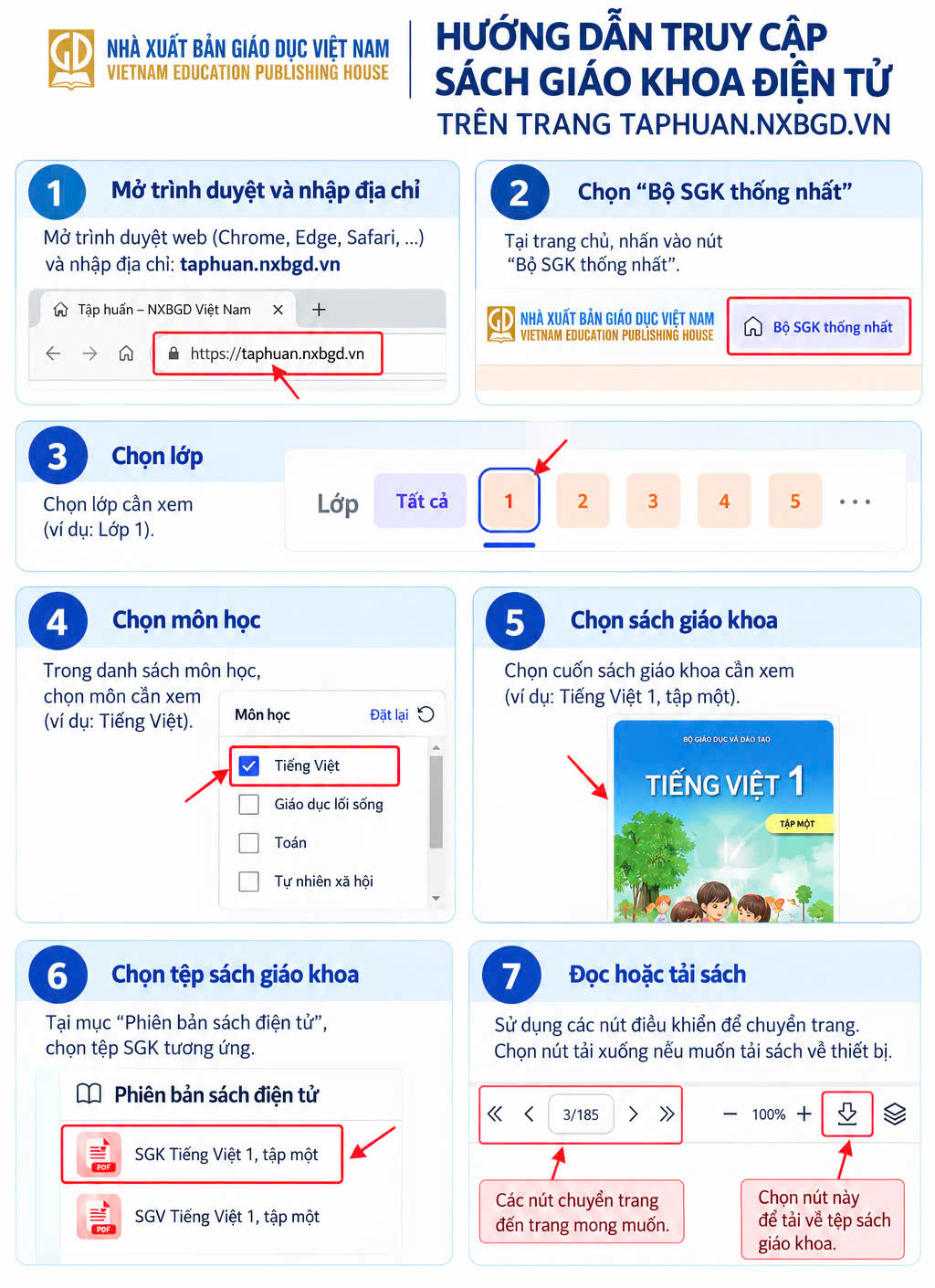
How to Access the Free Textbooks
The website is primarily in Vietnamese, so here's a quick guide:
-
Select "Bộ SGK thống nhất" (Unified Textbook Collection).
-
Choose "Lớp 1" (Grade 1), or another grade level.
-
Find "Tiếng Việt" (Vietnamese Language).
-
Select the textbook you'd like to explore.
-
Under "Phiên bản sách điện tử", click the textbook or supplementary resource you'd like to read.
-
Read the digital material online. Download availability may vary by resource.
The publisher states that these resources are free for teaching and learning purposes and are not intended for commercial use.
A Few Ideas for Teaching Vietnamese at Home
You don't have to recreate a Vietnamese classroom in your living room!
Here are a few ways to make the most of these resources:
-
Start small. Spend 10–15 minutes a day exploring letters, sounds, or new words together.
-
Connect lessons to everyday life. If your child learns the word cá (fish), talk about fish at dinner or while visiting an aquarium.
-
Read and talk together. Use the illustrations to ask questions, encourage storytelling, and practice everyday conversations in Vietnamese.
-
Make writing meaningful. Encourage your child to write a birthday card to bà ngoại, a short message to ông nội, or a few words about their favorite foods.
-
Follow your child's pace. These textbooks were designed primarily for children learning Vietnamese in Vietnam. Children growing up abroad may need additional oral-language practice and a more flexible approach.

Most importantly, remember that learning Vietnamese is not just about mastering spelling or pronunciation. It's also about helping our children build relationships, understand their cultural roots, and communicate with the people they love.
A Little Vietnamese Every Day Goes a Long Way ❤️
Whether your child is just beginning to recognize Vietnamese letters or is ready to read short stories, these free textbooks can be a valuable addition to your family's learning resources.
And for international friends interested in learning Vietnamese, they offer a fascinating glimpse into how children in Vietnam learn their language at school.
Save the link, explore the books, and share this resource with another family raising bilingual or multilingual children!
🔗 https://taphuan.nxbgd.vn/tap-huan
Note: These are official educational resources from Vietnam Education Publishing House. They are freely accessible for educational use, but the ability to download individual resources may vary.


